Sri Vidya Sadhana: The Sacred Path of Divine Wisdom 2
Sri Vidya Sadhana: The Sacred Path of Divine Wisdom 2
1. Introduction
Sri Vidya Sadhana is one of the most revered and esoteric spiritual paths within the Hindu tradition. Rooted in ancient scriptures and rich in mystical symbolism, Sri Vidya combines devotion (bhakti), knowledge (jnana), and ritual (karma) into a holistic spiritual discipline. It centers around the worship of the Divine Mother—Lalita Tripurasundari—as the Supreme Consciousness and the source of all creation. Sri Vidya is not merely a form of worship; it is a comprehensive path that promises both material well-being and ultimate liberation.
This article explores the origins, philosophy, practices, and significance of Sri Vidya Sadhana in detail.
2. Etymology and Meaning
The term Sri Vidya consists of two Sanskrit words:
- Sri: A term of reverence indicating prosperity, beauty, and auspiciousness. It is also another name for the Goddess.
- Vidya: Meaning knowledge or wisdom.
Thus, Sri Vidya translates to “auspicious knowledge” or “divine wisdom.” It represents sacred and mystical knowledge that leads to the realization of the ultimate truth—the union of the individual self with cosmic consciousness.
3. Historical and Scriptural Foundations
Sri Vidya has ancient roots and is mentioned in several scriptures, including:
- Vedas and Upanishads: While the Vedas do not refer to Sri Vidya explicitly, philosophical foundations such as non-duality and the worship of the Divine Feminine are present in texts like the Devi Sukta and Sri Sukta.
- Tantras: Sri Vidya is deeply embedded in Tantric literature, especially the Sri Lalita Sahasranama, Tripura Rahasya, Yogini Hridaya, and Rudra Yamala Tantra.
- Puranas: The Devi Bhagavata Purana and Kalika Purana describe Sri Vidya in mythological contexts.
Sri Vidya belongs to the Kaula school of Shakta Tantra and is especially prominent in the Dakshinachara tradition, known for its non-violent and inward-directed practices.
4. Central Deity: Lalita Tripurasundari
The presiding deity of Sri Vidya is Lalita Tripurasundari—the Divine Mother and Empress of the Universe—often depicted seated on a throne within the Sri Chakra (the sacred geometric diagram). She represents:
- Lalita: “She who plays”—the spontaneous, playful nature of consciousness.
- Tripura: “She who exists in all three worlds”—physical, astral, and causal.
- Sundari: “The most beautiful”—symbolizing ultimate spiritual beauty.
Lalita is seen as both Saguna (with form) and Nirguna (formless). She is the embodiment of the Shiva–Shakti union—the non-dual reality manifesting as duality for the sake of experience and devotion.
5. The Sri Chakra: Mystical Diagram of the Cosmos
A central element of Sri Vidya is the Sri Chakra (or Sri Yantra), a sacred geometric diagram made up of nine interlocking triangles:
- Five downward-pointing triangles represent Shakti.
- Four upward-pointing triangles represent Shiva.
Together, they form 43 smaller triangles, each symbolizing a cosmic power or principle. The Sri Chakra represents:
- The creation of the universe
- The journey of consciousness from the outer material world to the inner absolute
- The body of the Goddess Herself
Meditation and ritual worship of the Sri Chakra are primary practices in Sri Vidya.
6. Philosophical Foundations
6.1 Non-Dualism (Advaita)
Sri Vidya adheres to a non-dualistic philosophy where the Divine and the devotee are not ultimately separate. It asserts that the universe is a manifestation of the Divine Mother, and realization means recognizing one’s identity with Her.
As expressed in these statements:
- “Shivoham” – I am Shiva
- “Soham” – I am She (the Goddess)
6.2 Integration of Bhoga and Moksha
Sri Vidya is unique in offering both bhoga (worldly enjoyment) and moksha (liberation). It doesn’t view life and spirituality as separate but encourages the seeker to live fully, with awareness and sanctity.
6.3 Shakti as Supreme Reality
Unlike other traditions that place Brahman or Shiva as the ultimate reality, Sri Vidya asserts that Shakti (the Goddess) is the supreme substratum. She is Chit-Shakti—pure consciousness and power.
7. Initiation and Guru Lineage
Sri Vidya is a mantra-marga (path of mantras), and its practices are considered highly sacred and secret. Proper initiation (diksha) from a qualified guru is essential. Without initiation, the mantras and yantras are believed to lack potency.
This knowledge is passed down orally through an unbroken lineage (guru-shishya parampara). Notable traditions include:
- The Kamarupa lineage in Assam
- The Sringeri and Kanchipuram traditions in South India
- The Kaula and Trika lineages in Kashmir and Bengal
8. Practices in Sri Vidya Sadhana
8.1 Mantra Japa
One of the main practices is repetition of sacred mantras, including:
- Panchadasi Mantra: The 15-syllabled mantra
- Shodashi Mantra: The 16-syllabled mantra, considered more advanced
- Kamakala Kali, Mahashodashi, and other esoteric mantras
Each syllable is a divine energy, and chanting them purifies and transforms the practitioner.
8.2 Sri Chakra Puja
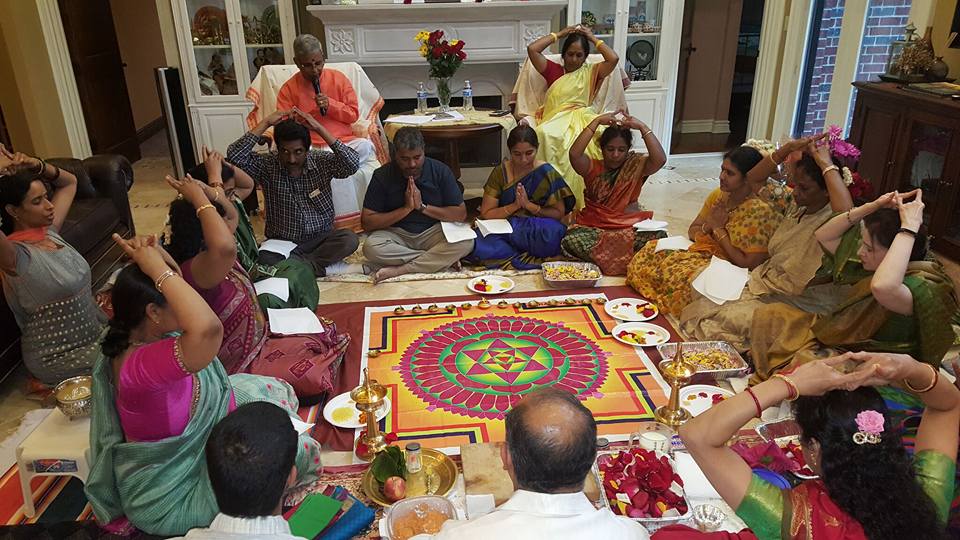
Worship of the Sri Chakra (in three-dimensional form as Meru Chakra or as a diagram) involves elaborate rituals with offerings, mudras, nyasas (placing deities on the body), and visualizations.
8.3 Nyasa and Dhyana
- Nyasa: Placing divine syllables or deities mentally or physically on different body parts, symbolizing the body as the temple of the Goddess.
- Dhyana: Meditative visualization of the Goddess, especially as described in the Lalita Sahasranama.
8.4 Tarpana and Homa
Offering oblations in water (tarpana) and fire (homa) to the deities of the Sri Chakra is an important practice to enhance the mantra’s power.
8.5 Silent Inner Worship
Advanced practitioners move from external rituals to antar-yaga—internal worship—where the Goddess is visualized in the heart, and the practitioner becomes one with Her.
9. Texts and Scriptures
Key scriptures of Sri Vidya include:
- Lalita Sahasranama: A thousand-name hymn full of symbolic and esoteric meaning.
- Tripura Rahasya: A philosophical treatise revealing secrets of the Goddess Tripura.
- Yogini Hridaya: Explains the internal meaning of the Sri Chakra and Yoginis.
- Saundarya Lahari: Attributed to Adi Shankara, describing the beauty and power of the Goddess.
10. Symbolism and Esoteric Teachings
Sri Vidya teachings are deeply symbolic:
- Tripura (Threefold Division): Represents body, mind, and soul; waking, dreaming, and deep sleep; past, present, and future.
- Bindu: The central point in the Sri Chakra, symbolizing the union of Shiva and Shakti—pure consciousness.
- Kamakala: The primal energy of desire and creation.
- Shodashi: Sixteen-fold perfection—the Goddess in Her fullest glory.
These symbols aim to transform consciousness both intellectually and experientially.
11. Goals and Benefits of Sri Vidya Sadhana
Material Benefits
Sri Vidya promises:
- Prosperity
- Fame
- Health
- Harmonious relationships
- Success in endeavors
These are considered natural blessings (prasada) of sincere devotion and practice.
Spiritual Realization
Ultimately, the practitioner seeks:
- Self-realization
- Unity with the Divine Mother
- Freedom from rebirth
- Blissful awareness (ananda)
Such a practitioner becomes a jivan-mukta—liberated while living.
12. Relevance in Modern Times
In today’s world, Sri Vidya offers:
- A holistic spiritual path that sanctifies, rather than rejects, worldly life
- A balance between outer activity and inner stillness
- Deep reverence for the feminine—much needed in patriarchal societies
- Tools for inner empowerment, emotional healing, and personal transformation
Its psychological depth, energy-based practices, and devotional beauty make it accessible and meaningful even today.
13. Conclusion
Sri Vidya Sadhana is one of the most refined and comprehensive spiritual paths. It integrates mantra, yantra, tantra, devotion, and philosophy into a living system that elevates the soul and beautifies life. At its heart is the profound truth that the universe is the Divine Mother’s playful dance—and we are all part of Her blissful movement.
To walk the path of Sri Vidya is to recognize the sacred in every moment, honor the divine feminine within and without, and awaken to the luminous truth that we are already divine.